

CYCLE 15
SAVAGE PROCESSES: GEOLOGY OF A SYNTHETIC STONE
19.09.2026 - 13.03.2027
COLLABORATION: eTHC / OPERACIONES
Concrete is the most heavily used material on earth. Its basic component and model, limestone (calcium carbonate, CaCO3 ), the raw mineral first processed into cement, is a sedimentary rock and biological byproduct that combined with water and sand have produced the foundation of the world today, concrete. And while cement is one of the most common forms in which calcium carbonate is found, it is not the only one. This matter circulates among rocks, water, organisms, and soil, contributing to processes that occur over vastly different time scales. Still, the industry has developed large-scale methods of extraction, processing, and production, transforming this geological material into an everyday commodity.
Today, the world is covered in concrete. We walk on it, breathe it in, and work with it —either directly or indirectly. The famous composite material is such a part of our daily lives that we forget about the geological history behind it, which transcends most of our experiential scales. With each transformation, multiple stories are inscribed: those of the earth it comes from, the organisms it interacts with, as well as the territories it modifies. The synthetic stone is both an agent and a witness. It participates in the spatial transformation of its milieu, while petrifying the traces of its seemingly imperceptible processes.
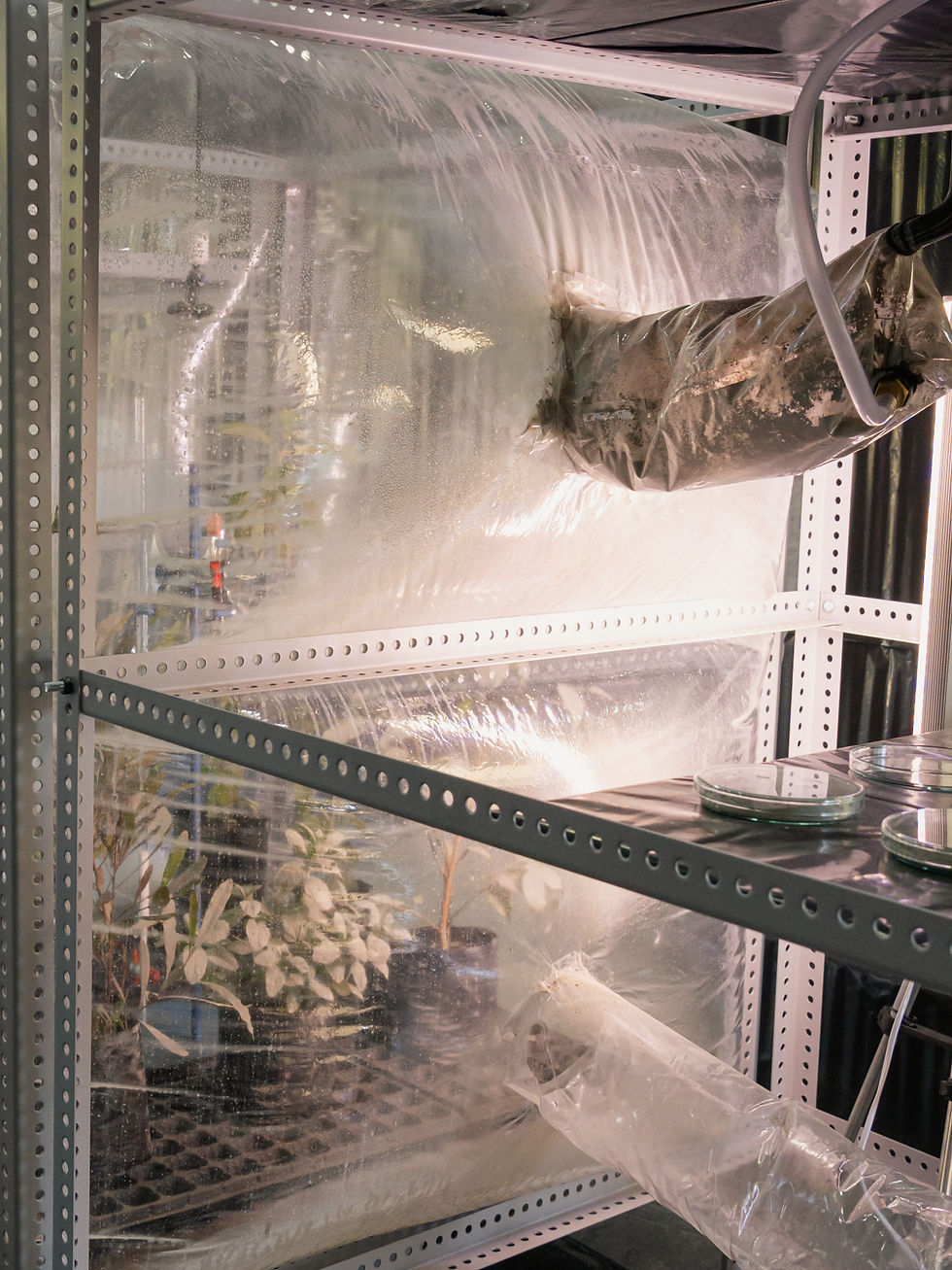
“Savage Processes: Geology of a Synthetic Stone” unfolds a theoretical, ecological, and political framework surrounding the environments related to limestone mining and cement production. The exhibition reflects and intercepts the changes and readjustments between natural (plant and mineral) and industrial materials, as well as the multispecies assemblies that shape the disputes over the surfaces it alters. Through a set of experimental models, the exhibition operates as a simulation, where processes that occur on other scales are accelerated, shifted, condensed, and reconstructed. A cave is an experiment; a leak becomes a simulation; and an antfarm, a whole territory. The result is not an exact copy of nature, but a new situation in which we can observe relationships through a different lens. By modifying their scale and environment, other forms of relationship between matter, territory, and time emerge, recognizing its parts as material witnesses, that is, as non-human entities and machinic ecologies that archive the complex interactions with a world decoded and reassembled into a story.



CREDITS
RESEARCH PROJECT
Operaciones / eHTC
Carlos A. Segura Jiménez
Dorian Z. Bell
Javier Peña Rodríguez
Luis A. Sánchez
Richard Gerald-Rondón
CURATOR
Tania Tovar Torres
CURATORIAL RESEARCH
Fernando Álvarez Camacho
Hermes Ríos Posada
CURATORIAL COORDINATION
Ricardo Betancourt Buelna
CURATORIAL ASSISTANTS:
Cecilia Ortíz Martínez
Eimi Gomez Ruiz
Dulce Harnández Juárez
VIDEO EDITING
Laura Méndez Pacheco
Operaciones / eHTC
DIGITAL MODELING
Javier Peña Rodríguez
GRAPHIC DESIGN
Estudio P
“Savage Processes: The Geology of a Synthetic Stone” is made possible thanks to the support of the Graham Foundation for Advanced Studies in the Fine Arts, and is presented as part of the Mextrópoli 2026 Architecture and City Festival.
